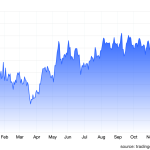




The Personal Consumption Expenditures (PCE) Price Index, the Federal Reserve’s preferred inflation gauge, rose by 0.49% month-over-month in September, reaching 132.257 from 131.611 in August. This reading signals persistent inflationary pressures, even as recent US labor market data for early November presents a complex picture. Initial jobless claims fell, suggesting resilient employment, but rising continuing claims indicate slower re-employment. This divergence in labor market health creates uncertainty for future consumer spending, which directly impacts PCE, complicating the Fed’s monetary policy path.
eToro is a multi-asset investment platform. The value of your investments may go up or down. Your capital is at risk. Crypto CFDs are not available to FCA / UK users.
The Personal Consumption Expenditures (PCE) Price Index, the Federal Reserve’s preferred inflation gauge, rose by 0.49% month-over-month in September, reaching 132.257 from 131.611 in August. This latest reading signals persistent inflationary pressures, even as more recent US labor market data presents a complex picture that could influence future consumer spending and, consequently, upcoming PCE readings. The diverging signals from jobless claims now add a nuanced layer to the Fed’s policy considerations, which are heavily guided by PCE trends.
On Thursday, November 5, 2026, Department of Labor figures indicated that initial jobless claims for the week ending October 31, 2026, fell by 6,000 to a seasonally adjusted 189,000. This result beat consensus estimates of 196,000 and pushed the four-week moving average down to 194,750, underscoring an environment where employers across most sectors remain reluctant to shed existing staff, which could support consumer income and spending.
The Lingering Challenge of Continuing Claims and PCE Outlook
However, the labor narrative is not one of uniform strength, posing potential headwinds for future PCE. Continuing jobless claims, which track individuals receiving ongoing unemployment benefits, climbed by 23,000 to 1,718,000 for the week ending October 24, 2026. This exceeded the consensus forecast of 1,710,000 and extended an upward drift from the prior week’s 1,695,000 reading.
This divergence illustrates a distinct “low-hire, low-fire” dynamic across the economy. While headline initial filings suggest high job retention and workforce stability, rising continuing claims show that once workers are displaced, re-entering the workforce takes longer. For job seekers, the hiring window has narrowed even as the safety net of existing employment remains intact, potentially dampening overall consumer spending and future PCE growth.
Fed’s Tightrope Walk: PCE Inflation vs. Labor Softening
This bifurcated backdrop complicates the Federal Reserve’s monetary path, particularly concerning its PCE inflation target. Subdued initial claims suggest that labor demand has not broken, which could support consumer spending and maintain vigilance around the Personal Consumption Expenditures (PCE) Price Index, the Federal Reserve’s preferred inflation gauge. With the Effective Federal Funds Rate standing at 3.88% following a shift from 3.75%, policymakers have maintained a restrictive stance to ensure price stability, with a keen eye on PCE trends.
Yet, the ongoing expansion in continuing claims suggests caution is warranted for future PCE readings. Prolonged job searches can eventually dampen household sentiment and curb discretionary consumption, potentially exerting a disinflationary pull on the PCE without requiring excessively aggressive policy tightening. Recent consumer sentiment readings from the University of Michigan stood at 48.1, reflecting lingering household uncertainty around long-term economic prospects, which could translate to softer consumer spending and a lower PCE in the months ahead.
Market Reactions: Repricing Across Rates and Risk Assets
Financial markets digested the data through the lens of interest rate expectations, considering its implications for the Fed’s PCE-driven policy. Fixed income markets reflected an active recalibration of the economic cycle: the 10-year Treasury yield hovered near 4.90%, while the 2-year Treasury yield traded around 4.58%. Meanwhile, the spread between 10-year and 2-year Treasuries widened to 0.38 percentage points on November 5, up from 0.32 earlier in the week, indicating that investors are pricing both short-term policy firmness and lingering structural growth dynamics.
Currency and risk assets also responded to the tighter policy outlook. The Trade Weighted U.S. Dollar Index traded around 121.67, reflecting steady demand for dollar-denominated assets. In cryptocurrency markets, digital assets like Bitcoin and major tokens faced headwinds as elevated benchmark yields maintained pressure on speculative liquidity and duration-sensitive trades.
What to Watch Next
Market attention immediately shifts to the October Nonfarm Payrolls report, scheduled for release on November 6, 2026, as a key indicator for future consumer spending trends and, by extension, the Personal Consumption Expenditures (PCE) Price Index. Consensus projections anticipate roughly 65,000 new payroll additions and an unemployment rate holding steady at 4.2%. Any unexpected deviation in hiring volume or average hourly earnings could quickly alter expectations for the Federal Reserve’s final policy meetings of the year, particularly concerning their inflation outlook as measured by PCE.
What is the latest PCE Price Index reading?
The September PCE Price Index rose by 0.49% month-over-month to 132.257, up from 131.611 in August.
Why is the PCE Price Index important for the Federal Reserve?
It is the Fed’s preferred inflation gauge, used to assess progress towards their 2% inflation target and guide monetary policy decisions.
How might current jobless claims data influence future PCE readings?
Low initial claims suggest stable income, supporting consumer spending, but rising continuing claims indicate slower re-employment, which could dampen overall consumption and put downward pressure on future PCE.
How does PCE relate to jobless claims?
PCE measures consumer spending and inflation, while jobless claims indicate labor market health, which influences consumer income and spending, thus impacting PCE.
A useful background piece for this story is What is CPI.