


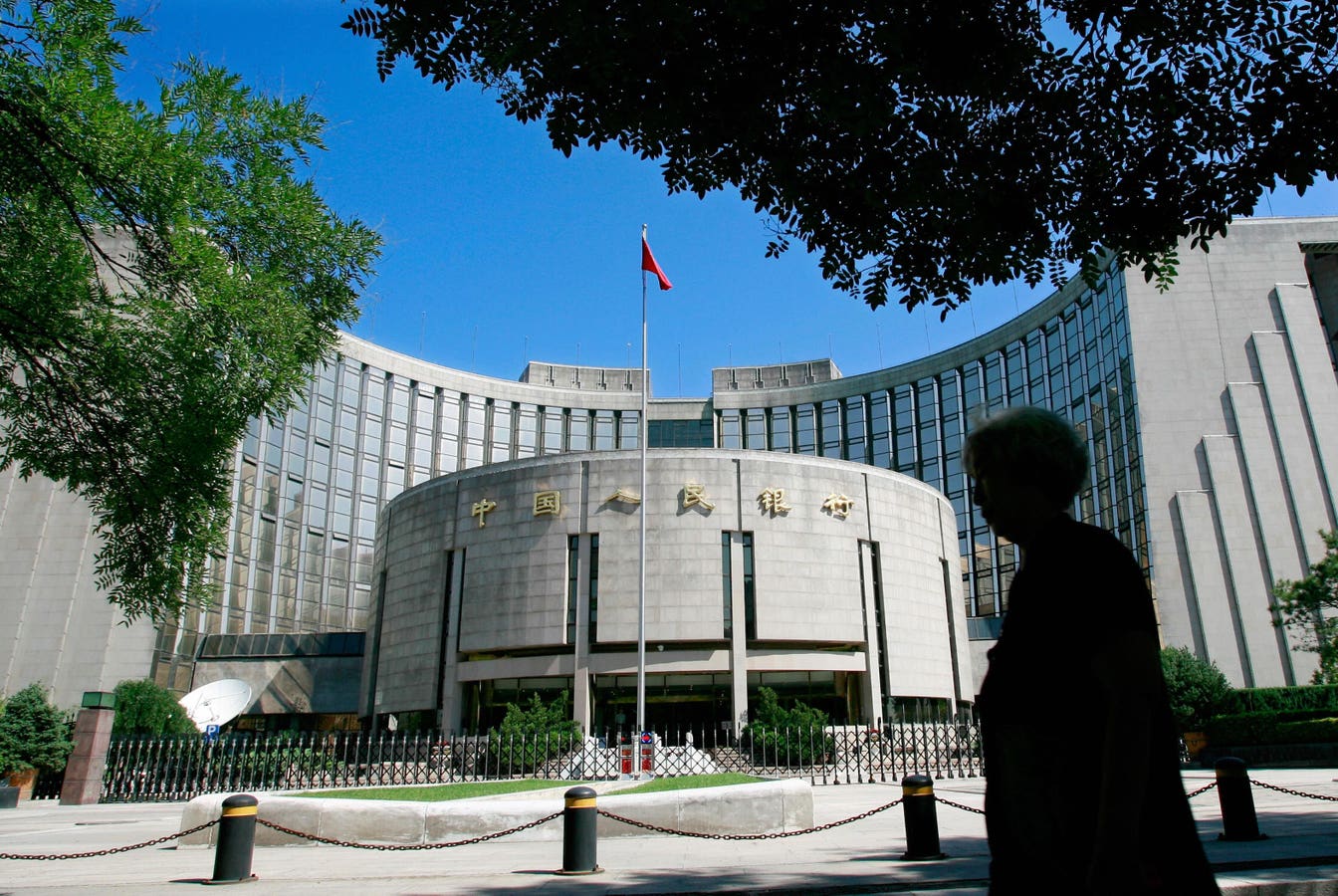
Will they…won’t they. Will China ever embrace a RMB-stablecoin? Not likely. (Photo credit should read TEH ENG KOON/AFP via Getty Images)
AFP via Getty Images
In February, eight Chinese agencies led by the People’s Bank of China issued a notice with an unambiguous core: no entity, including the overseas arms of Chinese firms, may issue renminbi-linked stablecoins abroad without approval, and tokenizing Chinese assets offshore now requires sign-off too. The directive cited the frequency of “speculative activities related to virtual currencies and the tokenization of real-world assets.” Two months later, Circle CEO Jeremy Allaire told an audience in Hong Kong there was a tremendous opportunity in a yuan-backed coin and that China could launch one within three to five years, while acknowledging the prerequisite buried in the forecast: renminbi convertibility.
The prediction industry keeps writing the yuan stablecoin into its forecasts because the strategic logic seems irresistible: the dollar has a state-blessed private token network and surely Beijing must answer in kind. The documents say otherwise, repeatedly and recently. The yuan stablecoin is the most confidently predicted product in financial geopolitics, and the government that would have to permit it has spent twelve months killing it in writing.
A trial balloon, shot down from inside
The sequence is worth laying out because it reads as policy discovery in real time. In August 2025, Reuters reported the State Council was reviewing a roadmap that might permit yuan-backed stablecoins, with Hong Kong and Shanghai as venues. What followed was a cascade of retractions. Days later, brokerages were told to stop publishing research endorsing stablecoins. In September, the securities regulator told firms to halt offshore tokenization work. In October, Ant Group and JD.com, the two most capable issuers in the country, shelved their Hong Kong stablecoin plans after the central bank and the cyberspace regulator ordered a halt; the PBOC reportedly objected to tech groups and brokerages issuing any type of currency at all. February’s eight-agency notice formalized the outcome.
Someone in Beijing floated convertibility-by-token, watched the implications propagate, and closed the file. That is the arc the yuan-stablecoin thesis has to explain away, and it cannot.
Hong Kong’s licenses prove the point
Hong Kong built the perfect laboratory for an offshore yuan coin. Its stablecoin ordinance, in force since August 2025, permits coins referencing any fiat currency in principle, and the city holds the world’s largest offshore renminbi pool, around one trillion yuan. Thirty-six firms applied. In April, the HKMA granted exactly two licenses, to HSBC and to Anchorpoint, the Standard Chartered, Animoca and HKT venture, both for Hong Kong dollar coins first. When a startup called AnchorX marketed an offshore-yuan token as the first of its kind, the HKMA publicly disowned it: no offshore yuan stablecoin had been approved, and any token claiming HKMA regulation was illegal. Chief executive Eddie Yue had warned all along that only a handful of licences would ever be granted.
The one jurisdiction with the legal framework, the liquidity pool and the political mandate to host a CNH stablecoin has approved everything except one. That is Beijing’s answer, delivered through Hong Kong’s licensing queue.
The queue itself keeps saying it. The HKMA missed its own March target for first licenses, granted two in April against 36 applications, and signals that even future grants will remain very limited, with HSBC’s Hong Kong dollar coin expected in the second half of the year. Fortune’s reading of the ordinance caught the essential clause: the framework could draw on the city’s offshore renminbi pool if the PBOC chooses. Eighteen months of evidence now sits on that “if,” all of it pointing the same way.
The controls are the currency
The reason lives in how China manages money. Chinese individuals face a $50,000 annual quota for foreign exchange conversion; the capital account is managed, everywhere, always. A freely transferable yuan token is a hole in that wall: anyone, anywhere, converting at any size, on rails Beijing does not control. As one University of Helsinki scholar of Chinese political economy put it, stablecoins can circulate beyond regulatory oversight, interfere with capital account management and complicate the central bank’s control over settlement. The yuan’s internationalization is real but deliberately slow: 3.1% of SWIFT payments in June against the dollar’s 50.1%, with China’s own CIPS system processing 180 trillion yuan in 2025.
Beijing wants that growth on rails with an approval step. Hence the actual buildout: the digital yuan’s international operations center opened in Shanghai last September, and in June, 26 financial institutions including Standard Chartered signed onto CBETS, the cross-border e-CNY transfer platform. The permissioned rail and the stablecoin solve the same problem, faster yuan settlement abroad. Only one of them preserves the approval step, and the approval step is the point.
The infrastructure Beijing does want is getting built with real ambition. PBOC governor Pan Gongsheng announced the Shanghai international center at the Lujiazui Forum in June 2025, and it opened with three platforms covering cross-border payment, blockchain services and digital assets. CIPS now counts 193 direct participants and more than 1,500 indirect ones. Standard Chartered’s China chief, signing onto CBETS, described the goal as an efficient, convenient and compliant cross-border payment experience, and compliant is the operative word: every participant is known, licensed and reachable. A bearer-style token network has none of those properties, which is precisely what its Western advocates like about it.
The market already voted, quietly
Here is the inconvenient control experiment: an offshore yuan stablecoin has existed since 2019. Tether launched CNH₮ that September. In February of this year, Tether discontinued it, stating that usage was insufficient to justify operational costs. Market capitalization at the end: around $3 million. Not billion. Seven years of a freely available offshore yuan token, from the issuer of the most successful stablecoin in history, found three million dollars of demand, against a dollar-stablecoin market the ECB puts at 99% of all supply. Offshore users who want digital dollars have them. Users who want yuan exposure have deposits and forwards. A yuan token adds convertibility risk that Beijing punishes, and demand priced that accurately. The dollar market it would compete against stood near $315 billion by spring, and Allaire’s own framing of the race, that currency competition is becoming a technological competition, contains the flaw in the forecast: for Beijing, currency technology that escapes licensing is a bug, and the feature Western issuers sell is the exact property Chinese law exists to prevent.
One name appears on both sides of the ledger and clarifies everything: Standard Chartered. Its Hong Kong arm co-owns Anchorpoint, one of the two licensed HKD stablecoin issuers; its China arm signed onto CBETS as a direct participant. The same institution issues a token where tokens are permitted and joins the permissioned rail where they are not, which is exactly how global banks read the map. Nobody at Standard Chartered is waiting for the CNH stablecoin, because the bank has seen which projects Beijing staffs and which it prosecutes.
What would actually change the answer
Two things, and only two. Full renminbi convertibility, which is the premise buried inside Allaire’s three-to-five-year forecast and which would constitute a different Chinese financial system entirely. Or a walled-garden CNH coin restricted to licensed corridors and whitelisted institutions, which is possible, plausible even, and functionally the e-CNY with extra steps. Voices inside the system do worry about the gap; a former Bank of China vice president has warned it would be a strategic risk if cross-border yuan payment stays less efficient than dollar stablecoins. Beijing’s chosen answer to that worry is faster permissioned rails, and the institutions signing onto CBETS suggest the answer is being built.
US policy circles treat the dollar’s stablecoin dominance as a race being won. The sharper reading is that the other superpower examined the race and declined to enter, because entry would cost the thing its monetary system values most: control of the exit. Every forecast of an imminent yuan coin is a bet that China will trade capital control for network growth. Nothing in twelve months of directives, license grants and product shutdowns suggests that trade is on the table. The yuan stablecoin is not late. It was never scheduled. For American policymakers the practical conclusion is almost anticlimactic: the GENIUS framework faces no symmetric rival, and the actual currency contest is between open dollar rails and permissioned yuan rails, a competition of architectures in which each side considers the other’s central feature a defect. Plan for that contest. Stop planning for the mirror image, because Beijing burned the mirror.