



Dogecoin [DOGE] and Shiba Inu [SHIB] started as internet jokes. Cut to today, they’re two of the most recognised memecoins in crypto!
But which of these is actually the better buy? This blog will help you find out, with a thorough comparison of key metrics and the numbers.
Both Dogecoin and Shiba Inu began as memecoins, but the underlying technology has taken them in different directions. While the former has stayed close to its original identity as a simple payment-focused cryptocurrency, the latter has expanded into a broader Ethereum-based ecosystem with more programmable use cases.
How does Dogecoin work?
Dogecoin runs on its own native blockchain and uses a Proof of Work (PoW) consensus mechanism. Its infrastructure is built for only for fast, low-cost peer-to-peer transfers.
It is easy to understand, relatively efficient for basic transactions, and well-suited to the kind of tipping and payment use cases it became known for. But that also creates limits. Dogecoin’s network is not designed for complex smart contracts, DeFi applications, or NFTs.
Its scalability is also fairly modest.
Shiba Inu: Ethereum-Based and More Programmable
SHIB is an ERC-20 token built on Ethereum, which means it can plug into Ethereum’s much larger smart contract ecosystem. That gives it access to more advanced blockchain functionality from the start.
Its infrastructure has also expanded through Shibarium, the L2 scaling solution designed to reduce costs and improve efficiency. Because SHIB is built in a smart contract environment, it can support more complex use cases such as staking, liquidity mining, NFTs, and DeFi mechanisms.
Dogecoin vs Shiba Inu: A look at the numbers
Dogecoin is still the bigger and more liquid memecoin right now. At the time of writing, DOGE has a market cap of $15.42 billion and 24h volume of $1.75 billion, per Coinmarketcap. That’s relatively stronger trading activity, with a circulating supply of 153.39 billion DOGE and no max supply.
Shiba Inu is smaller, with a market cap of $3.56 billion and 24h volume of $164.1 million. Its trading activity is lower than DOGE’s, but it still has a large community, with 2.9 million holders. SHIB also has a much bigger supply, with 589.24 trillion tokens in circulation and a max supply of 589.55 trillion.
Dogecoin [DOGE] in Recovery After Early Year Drop
The year so far for DOGE can be split into two phases. There was a huge early January rally, but it was followed by a correction and subsequently slow recovery.
DOGE began the year trading around $0.12-$0.13, before pushing toward $0.15; that was its early 2026 peak. However, that rally quickly lost pace. By early February, DOGE was in freefall, with a nearly 17-18% dip. That’s a drop of approx. −0.02750 from its January levels.
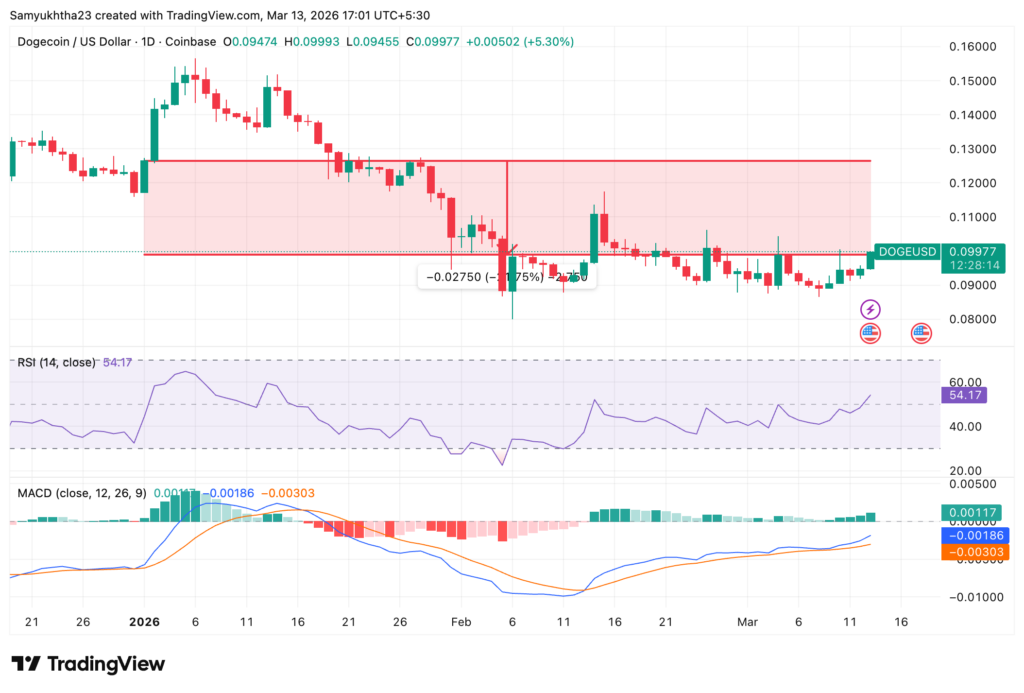
After this, the token began consolidating in February, and there’s been a gradual recovery since. At press time, DOGE traded at $0.10016, a +5.71% daily move on the chart.
RSI indicated neutral to bullish pace while MACD flipped slightly positive after weeks of bearish pressure. Selling pressure has eased, but things can be better.
Enter, Shiba Inu [SHIB]… With Slightly Better Pace
SHIB’s trajectory has been somewhat similar this year; an early rally, a mid-quarter correction, and a recent attempt at recovery.
The token started the year near $0.000007, briefly climbing toward $0.000009 in early January before reversing. By early February, SHIB had dropped roughly 21%, with a −0.00000157 fall from the January range.
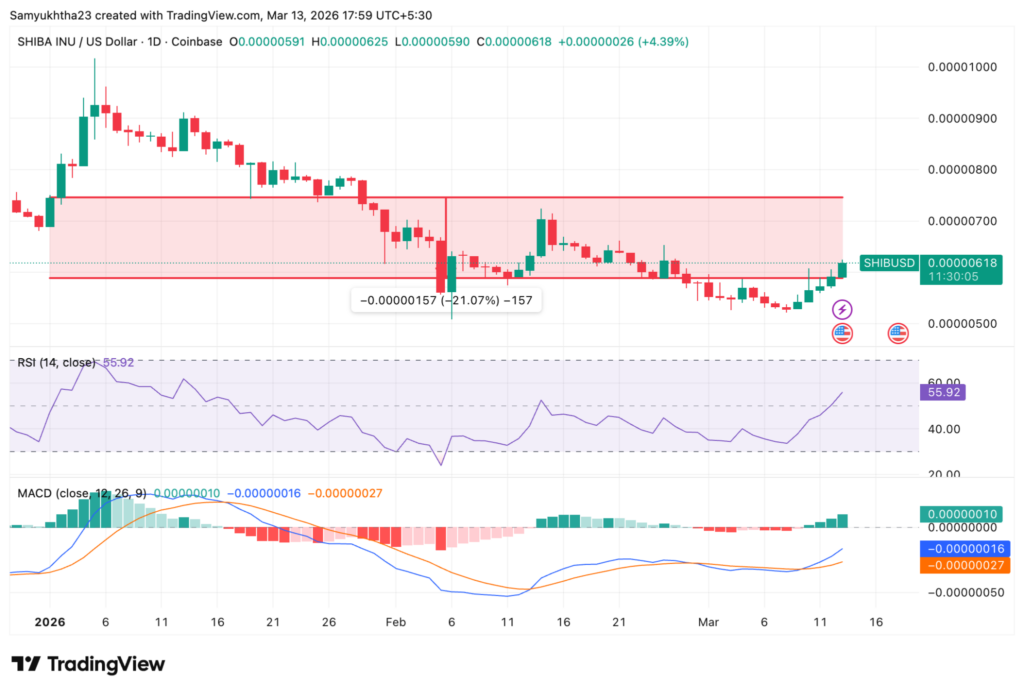
Since that low, SHIB has somewhat regained strength. At the time of writing, the token traded at around $0.00000618, gaining about +4.3% on the day.
Momentum indicators are slightly stronger compared to DOGE. RSI was at 55.92, while the MACD showed that better pace may be underway.
Tokenomics, Use Cases, and Real-World Utility
This is where the two projects start to look very different.
Dogecoin’s Simpler, Everyday Model
Dogecoin follows an inflationary model, which means it has no maximum supply and new DOGE continues to be issued through mining. That helps keep the token liquid and usable, but it also means supply keeps expanding over time. That can dilute scarcity.
Its utility is also straightforward. DOGE is mainly used for:
- payments and tipping
- microtransactions
- community-specific internet use cases
Low fees and popularity have helped Dogecoin stay relevant. It remains one of the most familiar crypto assets globally, and that brand strength is a real advantage.
Shiba Inu: More Utility, More Moving Parts
Shiba Inu’s model leans more deflationary, with token burns to reduce circulating supply over time. It also goes beyond a single-token setup by using:
- BONE for governance and utility
- LEASH as a scarcity-focused ecosystem token
Through ShibaSwap, users can stake tokens and provide liquidity. With Shibarium, the project also expands into lower-fee transactions, smart contract use cases, and a greater app ecosystem.
So if you value simplicity and brand power, DOGE has the edge. If you prefer ecosystem depth and a more utility-driven model, SHIB stands out more.
Dogecoin vs Shiba Inu at a Glance
| Metric | Dogecoin (DOGE) | Shiba Inu (SHIB) |
|---|---|---|
| Launch Year | 2013 | 2020 |
| Blockchain | Native Dogecoin blockchain | ERC-20 token on Ethereum |
| Consensus / Infrastructure | Proof of Work | Ethereum-based with Layer-2 |
| Maximum Supply | No max supply (inflationary) | 589.55T SHIB |
| Token Model | Inflationary | Deflationary (token burns) |
| Primary Use Cases | Payments, tipping, community transactions | DeFi, staking, ecosystem participation |
| Ecosystem Tokens | None | BONE, LEASH |
| Key Platforms | Simple P2P transfers | ShibaSwap, Shibarium |
| Community Strength | Massive global recognition | Large retail community |
Now that you have the information…
…you will be able to assess and make the right buying choice!
To manage risk better and make more well-informed investment decisions, check out more of our guides on Mudrex Learn or the Mudrex YouTube channel!
FAQs
Dogecoin or Shiba Inu – which is better?
Dogecoin is stronger in terms of market size and liquidity, while Shiba Inu offers a broader ecosystem with DeFi features and token burns. The better choice depends on whether you value simplicity or utility.
Does Dogecoin have more real-world adoption than Shiba Inu?
Yes, Dogecoin is more widely recognized and commonly used for payments and online tipping across the globe!
Why does Shiba Inu have such a large supply?
Shiba Inu launched with a very large token supply to keep prices extremely low and encourage retail participation, with token burns used to gradually reduce circulation.
Can Dogecoin reach higher prices than Shiba Inu?
Because Dogecoin has a much smaller circulating supply compared to SHIB, its price movements tend to appear larger on a per-coin basis.
DOGE v SHIB – Which has better long-term potential?
Dogecoin benefits from brand power and built credibility, while Shiba Inu is building a larger ecosystem.