




Bitcoin is down roughly 50% from its November 2025 high and sitting near $62,000, with momentum oversold. So has Bitcoin bottomed, or is there one more leg down before the cycle turns? Here’s how to read it — and what our 2026 cycle model says about where the low forms.
| Drawdown from peak | Spot price now | Monthly RSI |
|---|---|---|
| ~50% (off the Nov 2025 high) | ~$62K (
down from ~$126K) |
~35 (oversold territory) |
It’s the only question crypto investors are asking right now: has Bitcoin bottomed? After peaking around $126,000 last November, Bitcoin has spent 2026 grinding lower, and at roughly $62,000 it now trades about 50% below that high. The 14-day RSI has sat near 35 — oversold territory — and price is below both its 50-day and 200-day moving averages. To some, that screams capitulation and opportunity. To others, it looks like the middle of a longer bear market with further to fall. Both camps are loud. Neither can prove it in real time. What you can do is read the cycle honestly, and that’s what this guide is about.
Has Bitcoin Bottomed? The Honest Answer
Has Bitcoin bottomed? Honestly, nobody can confirm a cycle bottom while it’s happening — bottoms are only obvious in hindsight. What you can do is weigh the evidence: drawdown depth, oversold momentum, on-chain valuation, and where price sits in the broader halving cycle. In 2026, several of those boxes are ticking, but not all of them — which is exactly why the timing matters.
That last point is the whole game. Buying too early means sitting through more drawdown; waiting too long means missing the cheapest prices of the cycle. The rest of this post walks through the four signals we weigh, so you can judge the “has Bitcoin bottomed” question for yourself — and we’ll be upfront about which part of the answer lives in our research.
How Deep Is the Drawdown?
Every Bitcoin bear market has carved out a major low after a deep drawdown from the prior peak. The current ~50% decline from $126,000 is significant, but in cycle terms it sits in an ambiguous zone — painful enough to shake out leverage, yet not as extreme as the 70%+ collapses that marked some past bottoms. On its own, a 50% drawdown is necessary-but-not-sufficient evidence that Bitcoin has bottomed.
The nuance: not every cycle bottoms at the same depth, because the structure of the market changes. Heavier institutional ownership and spot ETF flows can cushion a decline, meaning a shallower drawdown might be “enough” this cycle. That’s a thesis you can argue either way — and how you weigh it shifts your answer.
Is Momentum Oversold Enough?
A monthly RSI near 35 tells you Bitcoin is oversold, and oversold conditions have historically clustered near cycle lows. But “oversold” is not the same as “bottomed.” Markets can stay oversold for weeks, and an RSI bounce can fail and roll over — the classic falling-knife trap. The recent action is a good example: Bitcoin tested the low $61,000s, then bounced back above $63,000 within a session. Was that the floor, or just a relief rally on the way down?
| KEY INSIGHT: Oversold momentum tells you the rubber band is stretched. It does not tell you when it snaps back. That’s why a single indicator never answers “has Bitcoin bottomed” — you need confluence across signals. |
Where Are We in the Market Cycle?
Bitcoin moves in recognisable cycles — accumulation, markup, distribution, and decline — and they have historically rhymed with the four-year halving rhythm. Mapping today’s price action onto that template is the single most useful exercise for the “has Bitcoin bottomed” question, because it reframes a scary daily chart into a position within a repeating structure.
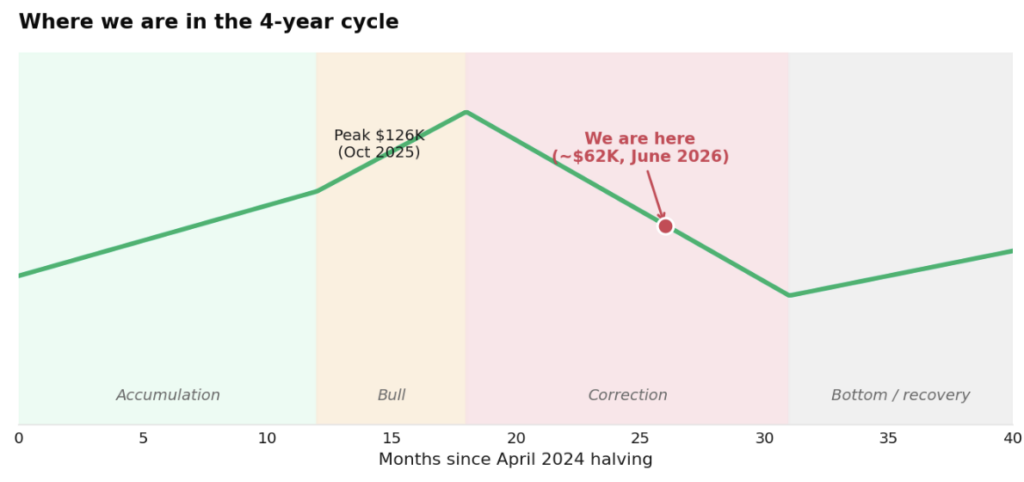
Our read is that Bitcoin is in the late-decline phase — past distribution, deep into the markdown, and approaching the zone where prior cycles found their footing. “Approaching” is the operative word. We share the specific bull, base and bear ranges further down; the timing — the window in which the bottom is most likely to arrive — is the piece the Mudrex Alpha report pins down, since that’s the actionable core of the research.
What Do On-Chain Valuation Metrics Say?
On-chain metrics give a valuation lens that price alone can’t. Two worth knowing: realized price (roughly the average cost basis of all coins) and MVRV (market value versus that realized value). When MVRV falls toward or below 1, it means the average holder is underwater — a condition that has historically coincided with major accumulation zones. Tracking how close current levels are to those historical thresholds is a cleaner way to ask “has Bitcoin bottomed” than staring at the spot price.
The honest caveat: on-chain thresholds are guides, not guarantees. They tell you when risk and reward have historically tilted in a buyer’s favour, not the precise day a bottom prints. Used together with drawdown, momentum, and cycle position, though, they raise or lower your confidence meaningfully.
Three Ways the Bottom Could Form in 2026
Rather than pretend to one magic number, we frame the bottom as three scenarios, each with a price range and the conditions that would trigger it. With Bitcoin near $62K today, all three sit below the current price:
1. Bull case: $55K–$60K — the recent test of the lows was effectively the floor, and Bitcoin builds a base in the high-$50Ks as ETF flows and easing macro liquidity do the work. The shallowest, fastest path.
2. Base case: $50K–$55K — one more controlled leg down into the $50–55K accumulation zone before the cycle turns — our central expectation, and the range we build the timing around.
3. Bear case: below $50K — a macro shock (recession, liquidity contraction, forced deleveraging) drags Bitcoin under $50K for a deeper, longer bottom.
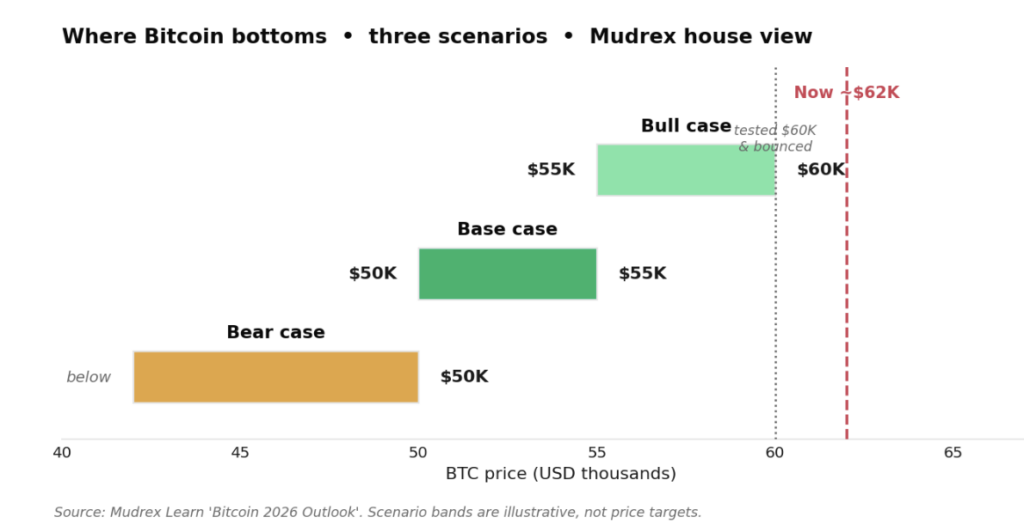
Those are the ranges. What the full Mudrex Alpha report adds is the timing — the specific window we expect the base-case bottom to form in — plus the on-chain and macro reasoning behind why each scenario triggers, and how to position for it.
What to Do If You Can’t Time the Exact Bottom
Here’s the freeing part: you don’t need to nail the exact bottom to come out ahead. The single most reliable answer to “has Bitcoin bottomed” for most investors is to stop trying to pick the day and instead dollar-cost average (DCA) into the accumulation zone. By buying fixed amounts on a schedule, you average into weakness, remove the emotion, and guarantee you’re buying through the bottom rather than guessing at it.
This is exactly why the report pairs its bottom call with a simple positioning framework rather than a single “buy here” price. On Mudrex, you can automate a DCA plan so the strategy runs without you having to watch the chart every day — which, for a question as unanswerable-in-real-time as this one, is the point.
Get the Full Has Bitcoin Bottomed? 2026 Analysis
This post covers the headline call — the bull, base and bear ranges for where the Bitcoin bottom forms. The full Mudrex Alpha report goes deeper: pinning down the timing window for the base-case bottom, mapping the on-chain and macro signals driving each scenario, and laying out exactly how to position for the turn.
Become a Mudrex Alpha member to access:
- The specific timing window we expect the base-case bottom ($50K–$55K) to form in.
- The full bull / base / bear breakdown with the on-chain and macro triggers behind each range.
- A three-strategy framework for positioning the bottom:
- Patient spot accumulation via automated DCA
- Staggered limit-ladder entries across the scenario zones
- Higher-beta futures positioning for the reversal
Already an Alpha member? The full report is live on the Mudrex app now.
Disclaimer: This is for informational purposes only and is not investment advice. Bitcoin and crypto futures are volatile and involve substantial risk of loss, including loss of principal. The use of leverage can amplify both gains and losses. Price levels, cycle scenarios, and on-chain figures are sourced from public trackers including CoinGecko, CoinMarketCap, Glassnode, DefiLlama, and Binance Research as of June 2026 and are subject to change. Always do your own research and never trade with capital you cannot afford to lose.