




Speculative investing in crypto means buying a digital asset primarily to profit from its price rising, trading on sentiment, momentum, or hype rather than underlying utility. The misconception examined here is that all crypto activity is speculative. It isn’t: stablecoins, smart contracts, DeFi lending, supply-chain traceability, and cross-border remittances represent cryptocurrency functioning as financial infrastructure not as a bet.
Key Takeaways
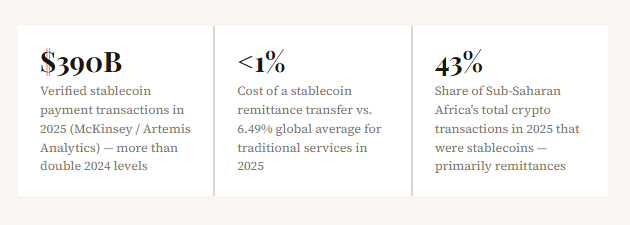
- McKinsey and Artemis Analytics identified ~$390 billion in verified real stablecoin payment transactions in 2025, more than doubling from 2024 in categories including B2B settlement, remittances, and payroll.
- DeFi protocols held $112 billion in Total Value Locked (TVL) by mid-2025; on-chain lending reached $73.6 billion by late 2025, serving borrowers who use crypto as collateral rather than as a speculative bet.
- Traditional remittances cost an average 6.49% globally in 2025 (8.78% in sub-Saharan Africa); stablecoin transfers cost under 1% and settle in minutes, 24/7.
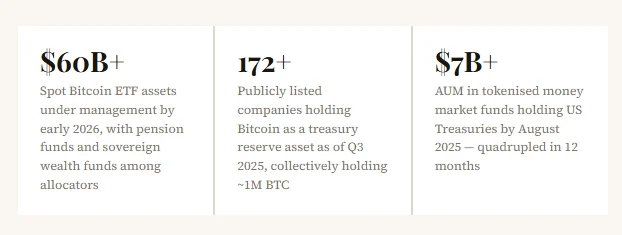
- 172+ publicly listed companies held Bitcoin as a treasury reserve by Q3 2025; spot Bitcoin ETFs exceeded $60 billion in AUM by early 2026, institutional adoption has moved from exploration to standard practice.
- Blockchain supply chain tools cut trade finance processing times by an average 81% and administrative costs by up to 42% real operational benefits divorced from token price movements.
- Speculation and utility are not mutually exclusive: Bitcoin can be simultaneously a speculative asset for a hedge fund and a remittance rail for a migrant worker. The honest framing acknowledges both.
Where Does the “Crypto Is Only Speculation” Myth Come From?
The misconception is grounded in genuine history. Bitcoin’s first decade was dominated by price cycles, the 2013 rally from $150 to $1,150, the 2017 ICO frenzy, the 2021 NFT bubble each followed by dramatic corrections that received far more media coverage than the quieter utility being built underneath. When the dominant headlines feature 80% portfolio drawdowns and celebrity token pumps, the speculative framing feels not just accurate but generous.
The framing also reflects a real structural truth: in developed markets, much crypto activity still runs on attention and price speculation. Chainalysis data shows that nearly 70% of all on-chain transactions in North America in 2024 were valued at over $1 million, tied to institutional players trading rather than spending. Memecoins, launched and abandoned in days on low-fee chains, epitomise the speculative extreme.
But parallel to the speculation, a different story was unfolding. In sub-Saharan Africa and Latin America, stablecoins were becoming primary remittance tools for people without bank accounts. Walmart was tracking produce on blockchain. Ethereum’s smart contract layer was processing billions in automated lending. The speculative framing is not wrong, it is incomplete. And incompleteness, when uncorrected, becomes a myth.
“Many of the most important blockchain use cases in 2025 stem not from speculation on volatile assets, but from the practical value the technology delivers: lower fees, faster transactions, stronger security, and greater transparency.”
How Is Crypto Used for Payments and Remittances?
Cross-border payments are the most documented and arguably the most impactful non-speculative use case for cryptocurrency. The global average remittance fee was 6.49% in 2025, reaching 8.78% in sub-Saharan Africa, meaning a family sending $200 to Nigeria loses $17.56 before the recipient sees a cent. Bank wire transfers take days. Correspondent banking excludes anyone without a verified account.
How Do Stablecoins Solve the Remittance Problem?
Stablecoins are cryptocurrencies pegged 1:1 to a fiat currency primarily the US dollar thus eliminating the price volatility that makes most crypto unsuitable for everyday payments. The sender converts local currency to USDC or USDT, sends it over a blockchain network that runs 24/7, and the recipient receives the equivalent in their local currency via a mobile wallet in minutes, at a cost of fractions of a cent per dollar sent. No bank account required. No business hours. No correspondent bank fees.
In 2025, stablecoins accounted for 30% of all crypto transaction volume (TRM Labs). The total stablecoin market cap broke $300 billion and continues to rise. Regulatory recognition is cementing their status: the US GENIUS Act (July 2025) requires 1:1 reserves and monthly reserve disclosures; the EU’s MiCA provides a harmonised issuance framework; Hong Kong passed its Stablecoin Bill. Stablecoins processed $18.6 billion in remittances to Southeast Asia in the first half of 2025 alone.
In Argentina and Venezuela, where local currency depreciation erodes savings rapidly, over 30% of digital wallets held stablecoins for daily spending in 2025. Digital currencies here are not speculative instruments, they are savings protection against inflation, serving a function closer to a bank account than to a casino chip.
The PayFi Shift: The 2025 PayFi Report found that 35–36% of users choose crypto for gaming, everyday purchases, and travel bookings. Shopify and Stripe both integrated stablecoin settlement in 2025, enabling merchants globally to accept and move digital dollars without converting through an exchange. Stablecoin-linked card spending reached $4.5 billion in 2025, up 673% from 2024 levels.
What Do Smart Contracts Actually Do?
Smart contracts are self-executing programs stored on a blockchain that automatically enforce the terms of an agreement when specified conditions are met, without requiring a lawyer, notary, or bank to verify the outcome. They have nothing to do with token price speculation. A smart contract either executes correctly or it does not; the price of ETH is irrelevant to whether a rental agreement automatically releases a security deposit after a lease ends.
Real-world applications are broad and growing:
Join UEEx
Music NFTs generated $520M+ in 2025. Artists retain up to 85% of primary sales and ~10% on every secondary resale via automated smart contracts versus $0.004 per stream on Spotify. 44% of independent musicians now use NFT platforms.
NFT Ticketing
NFT tickets are cryptographically unique and cannot be counterfeited. Smart contracts enforce resale price caps and pay royalties back to organizers on each secondary transfer. Market value reached $1.34B in 2025 at a 24.8% CAGR.
Digital Identity and Credentials
Over 12 million identity NFTs were issued in 2025 for education certificates, professional licences, and health credentials, where immutability and verifiability matter more than resale value.
In-Game Asset Ownership
Gaming NFTs represent 38% of total NFT transaction volume in 2025. Players in Axie Infinity, The Sandbox, and Decentraland hold assets with genuine transferable value — independent of any single company’s server.
The global NFT market reached an estimated $34.1 billion in 2025. Disney, Spotify, and Netflix launched token-gated content integrations, while major brands including Gucci and Balenciaga began accepting cryptocurrency payments. The speculative boom of 2021 was real — so is the underlying technology’s continued expansion into practical applications.
Join UEEx
Experience the World’s Leading Digital Wealth Management Platform
Sign UP
How Is Blockchain Used in Supply Chain and Healthcare?
These are perhaps the most compelling refutations of the “pure speculation” label, industries where blockchain’s value has nothing to do with token price appreciation and everything to do with data integrity, traceability, and fraud prevention.
What Is Blockchain’s Role in Supply Chain Management?
Supply chains suffer from data siloing, counterfeiting, and a lack of trusted information between parties who have no reason to take each other’s word for it. Blockchain provides a single, shared, tamper-proof ledger that all parties can read but no single party can alter.
| Company / Platform | Blockchain Use | Documented Outcome |
|---|---|---|
| Walmart | IBM Food Trust blockchain tracks produce from farm to shelf | Reduced time to trace food origin from 7 days to 2.2 seconds; improved contamination response |
| Maersk / IBM TradeLens | Blockchain-based trade documentation across global shipping | Digitised 100+ documents per shipment; reduced dwell times at ports |
| DHL / Accenture | Digital ledger for shipment tracking across 500,000+ US trucking companies | Single source of verifiability; reduced data siloing and fraud exposure |
| Pharma (general) | Drug traceability from manufacturer to dispensing pharmacy | Pharmaceutical blockchain could save $218B annually via fraud reduction (SQ Magazine, 2025) |
The blockchain supply chain market was valued at $3.7 billion in 2025. Smart contracts on these platforms lower administrative costs by up to 42% and cut invoice verification errors by approximately 38%. Trade finance processing times drop by an average of 81%. These are operational outcomes that persist whether Bitcoin is at $30,000 or $130,000.
Is Blockchain Transforming Healthcare?
The global blockchain in healthcare market was valued at $12.92 billion in 2025 and is projected to reach $234.97 billion by 2035 (Grand View Research, 33.65% CAGR). The primary applications are practical and non-speculative:
Electronic health records (EHRs): Patient records stored on a distributed ledger can be shared securely between providers while remaining under patient control — solving the interoperability and privacy challenge that has plagued healthcare IT for decades. Drug traceability: An immutable record of every step in a pharmaceutical supply chain makes counterfeit drugs detectable before they reach patients. The Uganda government partnered with UK-based Medi-connect precisely for this purpose. Clinical trial integrity: Recording trial data on-chain before analysis prevents post-hoc manipulation of results — a significant problem in academic research. Insurance claims automation: Smart contracts processing claims against verified data reduce administrative costs and fraud simultaneously.
Can Cryptocurrency Be Used for Charitable Giving?
Crypto’s pseudonymous transparency — where transactions are publicly verifiable on a blockchain even when linked to a wallet address rather than a name — makes it particularly well-suited to charitable giving contexts where donors want assurance that funds reached their intended destination without being diverted.
Major charities including UNICEF, the Red Cross, Save the Children, and the World Food Programme all accept cryptocurrency donations. Blockchain-based donation platforms allow donors to track exactly how funds move through an organisation — something impossible with a traditional bank transfer. For cross-border disaster relief, crypto enables near-instant fund movement to regions where banking infrastructure has been damaged or is simply absent. El Salvador’s 2025 reform of its Bitcoin law included new Bitcoin-based financial tools specifically for families receiving remittances, illustrating government-level recognition of crypto’s practical utility in underserved populations.
How Are Institutions Using Crypto Beyond Speculation?
Perhaps the strongest evidence that crypto has moved beyond pure speculation is the behaviour of institutions that operate under fiduciary duty, risk management oversight, and regulatory scrutiny — environments where “we bought it hoping it goes up” is not an adequate board-level justification.
What Does Institutional Adoption Actually Mean?
Companies like MicroStrategy, Tesla, and Block hold Bitcoin as a treasury asset — treating it as a hedge against fiat currency debasement, analogous to how prior generations held gold. Over 172 publicly listed companies collectively hold approximately 1 million BTC as of Q3 2025. The US government established a Strategic Bitcoin Reserve in March 2025, formally treating Bitcoin as a macroeconomic tool comparable to gold reserves. The framing of Bitcoin as a “speculative bet” is difficult to sustain when sovereign governments are acquiring it as a reserve asset.
Tokenised real-world assets (RWAs) — bonds, real estate, money market funds — represented one of 2025’s most significant institutional trends. BlackRock, Fidelity, and JPMorgan are all active participants. The tokenised RWA market grew from $24 billion to $33.91 billion through 2025. The OCC granted conditional national bank charter approvals to BitGo, Circle, Fidelity Digital Assets, Paxos, and Ripple in December 2025, moving stablecoin and custody infrastructure inside the federal banking perimeter — a definitive signal that crypto is being absorbed into regulated financial infrastructure, not merely tolerated as a speculative fringe.
VC investment in US crypto companies rebounded sharply: $7.9 billion deployed in 2025 (PitchBook), up 44% from 2024, with median deal sizes climbing 1.5x and deal volume falling 33% — a pattern consistent with investors prioritising quality over quantity, driven by enterprise and retail demand for genuine utility rather than fragile speculation.
Why Does Crypto Education Matter for Navigating the Speculation Question?
The challenge for anyone entering the crypto space is that speculation and utility genuinely coexist — sometimes within the same asset at the same moment. Bitcoin is simultaneously a speculative trading vehicle for hedge funds and a remittance rail for migrant workers in Southeast Asia. Ethereum powers billion-dollar DeFi protocols and memecoins that disappear in 48 hours. The correct response to this complexity is not to simplify it into “all speculation” or “no speculation” — it is to develop the literacy to distinguish between them.
Practically, this means asking different questions for different activities: Is this asset’s value tied to a real utility that persists regardless of price? (USDC: yes. A purely hype-driven memecoin: no.) Is this investment based on a belief in future price appreciation, or on earning yield from a verifiable service? Does the underlying protocol have paying users and genuine adoption independent of its token price?
Understanding crypto market volatility, staying updated on regulatory frameworks, and maintaining risk management discipline all become substantially easier when the foundational question “is this speculation or utility?” is answerable with the right tools. The resources available for this education have never been better: on-chain analytics, regulatory disclosures, project audits, and established financial education frameworks now all apply to crypto in ways they did not in 2017.
Join UEEx
Experience the World’s Leading Digital Wealth Management Platform
Sign UP
Frequently Asked Questions
Is cryptocurrency only for speculative investing?
No. Speculation is a real and significant component of crypto markets, but it coexists with documented utility: stablecoins processed approximately $390 billion in verified real payment transactions in 2025 (McKinsey/Artemis Analytics); DeFi protocols held $112 billion in TVL; blockchain supply chain tools cut trade finance processing times by 81%; and 172+ public companies hold Bitcoin as a treasury reserve. The honest framing is that crypto has genuine speculative and genuine utility dimensions operating simultaneously.
What is cryptocurrency used for besides investing?
Documented non-speculative uses include: cross-border remittances with fees under 1% vs. the 6.49% global average for traditional services; decentralised lending and borrowing, the on-chain lending market reached $73.6B in late 2025; smart contract automation for royalties, insurance, payroll, and trade finance; NFT-based digital ownership in music, ticketing, and credentials; supply chain traceability (Walmart, Maersk, DHL); healthcare data security and drug tracking; charitable giving with transparent fund trails; and institutional treasury allocation with spot Bitcoin ETFs holding $60B+ in AUM by early 2026.
How are stablecoins different from speculative crypto?
Stablecoins are pegged 1:1 to a reserve asset (typically the US dollar) and are explicitly designed to hold a fixed value, the opposite of speculative appreciation. The total stablecoin market cap exceeded $300 billion in 2025. Regulation formalised their status: the US GENIUS Act (July 2025) requires 1:1 reserves and monthly disclosures; the EU’s MiCA provides a harmonised framework. Tether (USDT) and USDC account for 93% of the stablecoin market cap and are increasingly treated as payment infrastructure by Stripe, Shopify, Visa, and Mastercard.
What is DeFi and is it just speculation?
DeFi (Decentralised Finance) uses smart contracts to provide financial services like lending, borrowing, trading, yield, without banks or brokers. Some DeFi activity is speculative (leveraged derivatives, volatile yield farming), but much serves genuine utility: collateralised lending lets borrowers access liquidity without selling assets; stablecoin savings products offer 4–8% APY to people in high-inflation economies; tokenised US Treasury funds provide institutional-grade yield on-chain. The DeFi market is forecast to grow at a 43.3% CAGR through 2030, driven by expanding practical use cases.
How is blockchain used in supply chain management?
Blockchain provides a tamper-proof shared ledger for tracking goods and verifying transactions across complex supply chains. Walmart reduced food origin tracing from 7 days to 2.2 seconds using IBM Food Trust. DHL tracks shipments across 500,000+ US trucking companies. Pharmaceutical blockchains track drugs from manufacturer to pharmacy, potentially saving $218 billion annually via fraud reduction. The blockchain supply chain market was valued at $3.7 billion in 2025. Smart contracts cut trade finance administrative costs by up to 42% and processing times by 81%.
Can cryptocurrency help unbanked populations?
Yes, stablecoin remittances are perhaps the most compelling documented example. Approximately 1.4 billion adults globally remain unbanked, but most have smartphones. In Sub-Saharan Africa, stablecoins accounted for 43% of total crypto transactions in 2025, primarily for remittances and savings. Traditional transfers to sub-Saharan Africa cost 8.78% on average; stablecoin transfers cost under 1% and settle in minutes. In Argentina and Venezuela, 30%+ of digital wallets hold stablecoins for daily spending as inflation protection. Celo saw 700,000 daily active users via mobile-first stablecoin payments in 2024.
How are institutions using crypto beyond speculation?
Institutional crypto use has shifted substantially from speculation to strategic allocation and infrastructure. Spot Bitcoin ETFs held $60B+ in AUM by early 2026; 172+ public companies held Bitcoin as treasury by Q3 2025. The US government established a Strategic Bitcoin Reserve in March 2025. Tokenised US Treasury funds grew from $2B to $7B+ in AUM within 12 months. The OCC granted conditional bank charters to BitGo, Circle, Fidelity Digital Assets, Paxos, and Ripple in December 2025, moving stablecoin infrastructure inside the federal banking perimeter. 76% of global investors plan to expand digital asset exposure in 2026.
What is the difference between speculative crypto and utility crypto?
Speculative crypto involves buying assets primarily to profit from price appreciation, the value proposition depends on someone paying more later. Utility crypto involves using digital assets as functional tools: USDT/USDC for payments, ETH as gas for smart contract execution, AXS/SAND for in-game economies, CHZ for fan engagement voting. The distinction matters for regulation, taxation, and risk. Most regulatory frameworks in 2025/2026 treat these differently. The same asset can serve both roles simultaneously. Bitcoin is speculative for a hedge fund and utility infrastructure for a remittance network at the same moment.