




Gold futures are one of India’s most actively traded derivatives. They help investors hedge against inflation, speculate on price movements, and diversify portfolios without physically owning gold. But while the market is lucrative, few traders fully understand how their profits are taxed.
This guide unpacks everything about the taxation of gold futures in India: how it works, what laws apply, and how to file correctly to avoid penalties and maximize returns.
Understanding Gold Futures
Gold futures are standardized contracts traded on exchanges like the Multi-Commodity Exchange (MCX) that allow traders to buy or sell a specific quantity of gold at a predetermined price on a future date.

Unlike owning physical gold, trading gold futures involves no delivery of the metal. Instead, traders profit from the difference between entry and exit prices.
Why Traders Prefer Gold Futures
- Leverage: Trade larger positions with smaller capital.
- Liquidity: MCX contracts are highly liquid, ensuring quick entry and exit.
- Hedging tool: Helps jewellers, importers, and investors offset price risks.
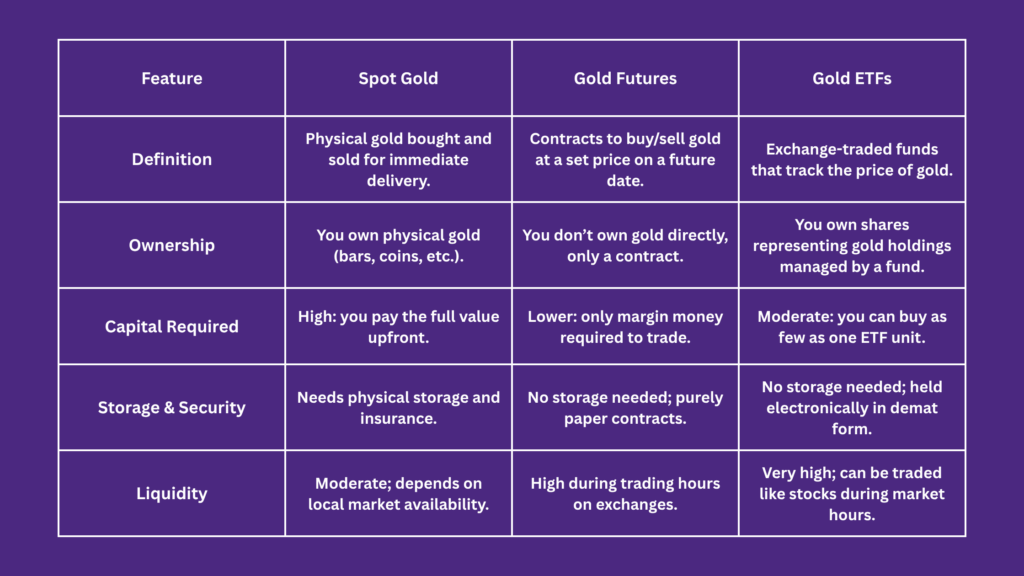
Taxation of Gold Futures: How Gold Futures Are Taxed in India
The Income Tax Act, 1961, governs how profits from trading gold futures are taxed. The key lies in how your transactions are classified: speculative or non-speculative.
Speculative vs. Non-Speculative Income
- Speculative Transactions
- It occurs when trades are settled without actual delivery.
- Example: Intraday or same-day futures trades.
- Taxed under “Income from Business or Profession” but cannot offset non-speculative losses.
- Non-Speculative Transactions
- Applicable to futures contracts that are settled or carried over.
- Treated as business income, not capital gains.
- Expenses related to trading (brokerage, internet, analysis tools) are deductible.
Example:
If you trade MCX Gold futures and settle contracts on expiry, it’s non-speculative income. If you close the position intraday, it’s speculative.
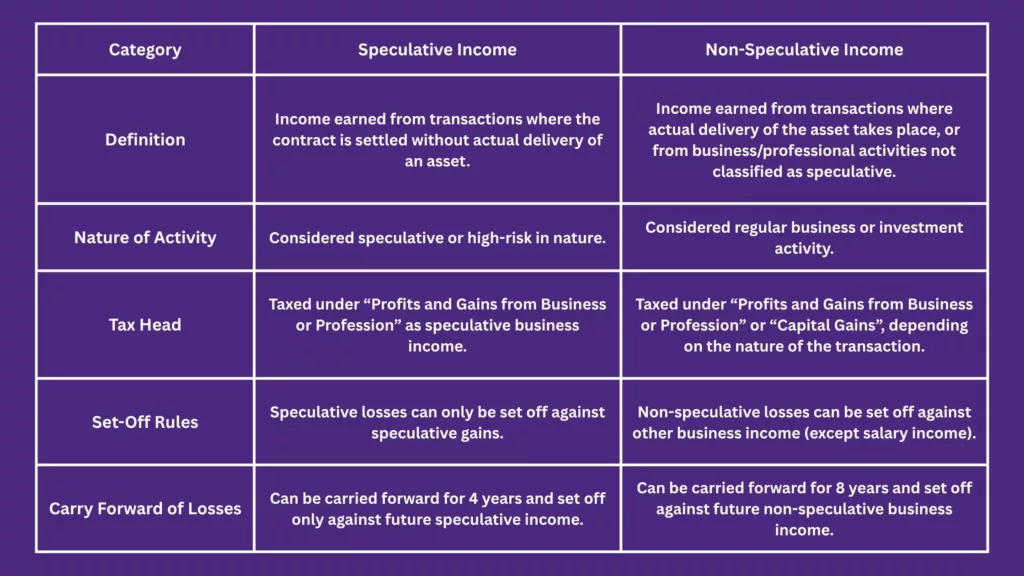
Business Income vs. Speculative Income
Tax on Speculative Income
- Added to total income and taxed at slab rates.
- Cannot be adjusted against other non-speculative income.
- Losses can be carried forward for 4 years.
Tax on Non-Speculative Income
- Considered part of business income.
- Eligible for deductions such as:
- Brokerage and transaction fees.
- Internet and subscription charges.
- Advisory or research expenses.
- Losses can be carried forward for 8 years.
Example:
If your trading activity resembles a business, multiple trades, system setup, and analysis tools, then gold futures income should be treated as non-speculative business income.
Read More: How Are Crypto Futures Taxed in India?
Taxation of Gold Futures: Filing and Reporting Gold Futures Income
All profits and losses from gold futures must be reported under the ‘Income from Business or Profession’ head in ITR-3.
Taxation of Gold Futures: Step-by-Step Reporting Process
- Calculate turnover: For futures, turnover equals the absolute profit or loss (sum of positive and negative differences).
- Determine tax regime: Decide whether you fall under normal slab rates or presumptive taxation.
- File ITR-3: Declare business income, deductions, and expenses.
- Maintain records: Keep broker statements, contract notes, and expense receipts for at least 6 years.
Audit Requirements
A tax audit under Section 44AB is mandatory if:
- Turnover exceeds ₹1 crore, or
- Exceeds ₹10 crore with >95% digital transactions.
Advance Tax and TDS
Traders with tax liability exceeding ₹10,000 must pay advance tax quarterly. No TDS applies to futures income directly, but brokers may deduct GST on fees.
Taxation of Gold Futures: GST Implications
While trading gold futures, there is no GST on profit or loss itself. However, GST applies to brokerage and exchange transaction charges.
GST Breakdown Example
| Component | Rate | Example Amount (₹) |
| Brokerage | 18% GST | 90 |
| Exchange Charges | 18% GST | 30 |
| Total GST Paid | ₹120 |
These charges can be claimed as business expenses, reducing taxable income.
Taxation of Gold Futures: Common Mistakes Traders Make
Even experienced traders often miss small but important tax rules. Some common pitfalls include:
- Not maintaining trade records: Missing contract notes can complicate audits.
- Misclassifying income: Treating all trades as speculative.
- Ignoring audit requirements: Failure to audit when turnover crosses limits.
- Skipping advance tax payments: Leading to interest under Sections 234B/C.
- Assuming futures profits are tax-free: Unlike long-term capital gains, futures profits are fully taxable.
Taxation of Gold Futures: How to Minimize Tax Liability Legally
Traders can use legitimate methods to reduce the overall tax burden:
1. Claim Allowable Expenses
Deduct costs like:
- Brokerage and internet bills
- Laptop depreciation
- Subscription to data analysis tools
- Research reports and advisory fees
2. Set Off Losses
- Speculative losses → can offset only speculative gains.
- Non-speculative losses → can offset any business income.
- Carry forward for up to 8 years.
3. Use Presumptive Taxation (Section 44AD)
Small traders with a turnover under ₹2 crore can declare 6% of their turnover as income and skip detailed bookkeeping.
4. Choose the Right ITR Form
Use ITR-3 for detailed reporting or ITR-4 for presumptive taxation.
The Future of Taxation of Gold Futures in India
The government and regulators are gradually considering aligning commodity, equity, and crypto derivatives under similar taxation frameworks.
Key Trends Ahead
- Unified tax reporting: CBDT and SEBI plan standardized reporting for derivative instruments.
- AI-based audits: Automated systems to detect mismatched income vs. broker data.
- Increased transparency: Exchanges share trader-level data with tax authorities for compliance.
Traders should expect more digital scrutiny but also easier pre-filled ITRs in the near future.
Conclusion
Understanding the taxation of gold futures in India is vital for anyone trading in commodity derivatives. By recognizing how income is classified, maintaining proper records, and using legal deductions, traders can stay compliant while optimizing returns.
Tax-smart trading isn’t about evasion; it’s about informed decision-making. Stay aware, file accurately, and let your profits reflect both smart trades and smart compliance.
Want to learn more about how crypto, commodities, and derivatives taxation works in India?
Explore Mudrex Learn for expert guides and weekly explainers.
Subscribe to the Mudrex YouTube channel for step-by-step tutorials on tax filing, trading psychology, and risk management.
FAQs
1. Are profits from gold futures considered capital gains or business income?
They are treated as business income, not capital gains, since futures trading is a business activity.
2. What is the tax rate on gold futures trading profits?
Profits are taxed at your applicable income tax slab rate under business income.
3. Is GST applicable on gold futures trading?
No direct GST applies to gold futures, but brokerage and exchange fees attract GST at 18%.
4. Can gold futures losses be carried forward?
Yes, non-speculative losses can be carried forward for up to eight assessment years.
5. Do small traders need to maintain books of accounts?
Yes, if turnover exceeds ₹2.5 lakh or income crosses the basic exemption limit.